No products in the cart.
Blog
What Is Amazon Liquidation Pallets?
28
Jun
Jun
If you are looking at bulk inventory for resale, you have probably asked some version of the same question: what is amazon liquidation pallets, and is it actually worth buying? The short answer is that Amazon liquidation pallets are bulk lots of returned, overstocked, or unsold merchandise sold off to secondary market buyers. For resellers, they can be a real margin opportunity – but only if you understand what you are buying.
This is not the same as ordering new, case-packed wholesale goods with uniform SKUs and guaranteed shelf-ready condition. Liquidation is a different lane. The pricing is lower because the inventory is less predictable, the condition can vary, and the buyer takes on some sorting and recovery work. That trade-off is exactly why experienced resellers pay attention to it.
What are Amazon liquidation pallets?
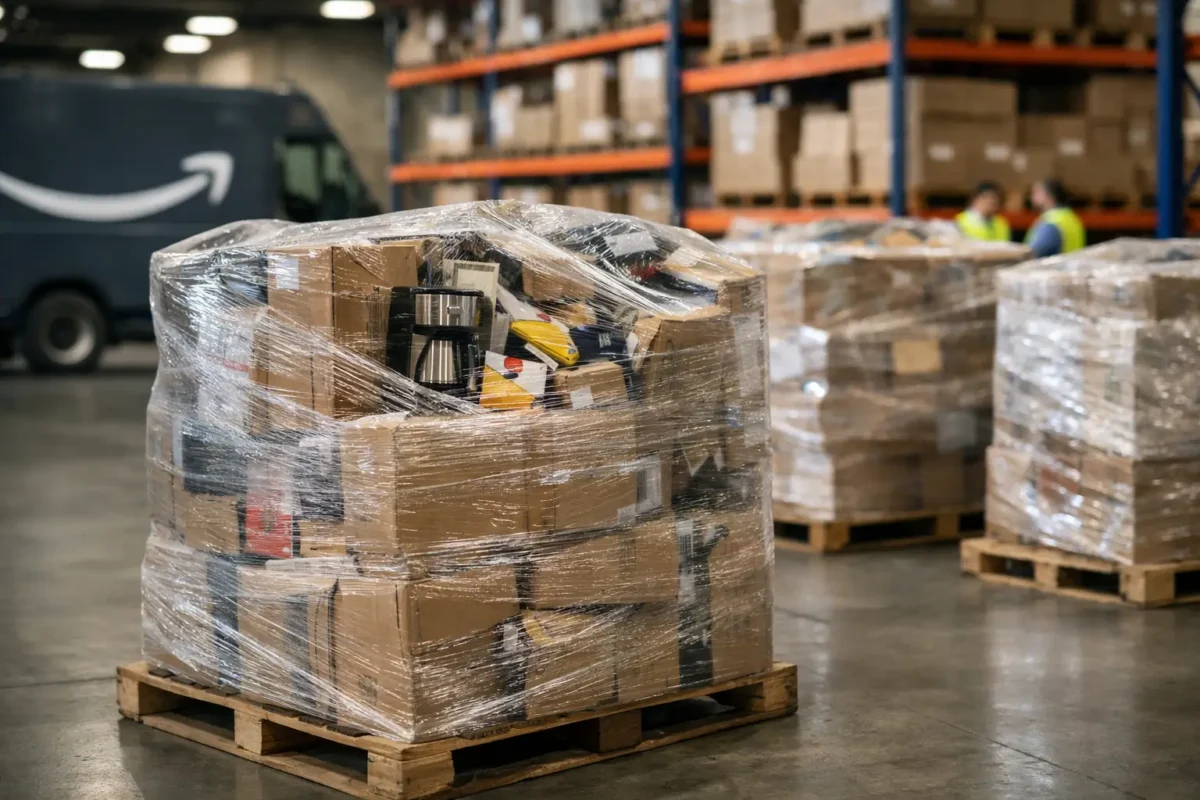
Amazon liquidation pallets are grouped loads of merchandise that move out of the primary retail channel and into the liquidation market. These pallets may include customer returns, overstock items, damaged box goods, shelf pulls, or mixed lots from fulfillment and reverse logistics streams.
The pallet format matters because it lets buyers purchase inventory in bulk at below-retail pricing. Instead of sourcing one product at a time, a reseller can buy an entire pallet or truckload and process it for multiple sales channels, whether that is a discount store, flea market booth, bin store, online marketplace, or local resale operation.
In practice, these pallets are often sold by category, condition, or inventory type. One load might lean heavily toward home goods and kitchen items. Another might be mixed electronics, tools, small appliances, apparel, toys, or seasonal merchandise. Some are more organized and manifest-based. Others are unmanifested and require the buyer to work through the pallet item by item.
Why Amazon inventory ends up in liquidation
A lot of new buyers assume liquidation means the products have no value left. That is not how the market works. Retailers and major distribution systems move inventory fast, and liquidation is often the most efficient way to recover value from goods that no longer fit standard retail handling.
Customer returns are a major part of the pipeline. A product may come back because the buyer changed their mind, ordered the wrong size, or opened the package and decided not to keep it. That does not always mean the item is broken. It just means it has left the clean, first-sale retail cycle.
Overstock is another common source. When a retailer holds too much inventory, needs warehouse space, or wants to clear slower-moving SKUs, liquidation becomes a fast exit path. Seasonal transitions also matter. Products tied to holidays, weather, or short sales windows often move to secondary channels once the primary demand window closes.
Then there are shelf pulls and box-damaged goods. A shelf pull may still be fully functional and marketable, but it may have outdated packaging, store wear, or labeling issues. A box-damaged item can still resell well, especially if your customer base is price-driven and less concerned with perfect presentation.
What you might find inside a pallet
The contents depend on the load type, the supplier, and the condition grade. That is why serious buyers never treat all pallets as equal. A mixed pallet could contain fast-moving items with solid resale potential, or it could include slower inventory that takes more labor to sort and sell.
You may find small electronics, phone accessories, tools, kitchenware, health and beauty products, clothing, shoes, toys, household goods, pet items, or general merchandise. Some buyers prefer mixed pallets because the variety spreads risk across categories. Others want more targeted pallets so they can stay in their strongest resale lane.
Condition is the real variable. Some items may be new in box. Others may be open box, tested working, incomplete, cosmetically imperfect, or salvage grade. That range is why the buy cost can look attractive on paper while the actual recovery rate depends on your operation. A buyer with testing capacity, repair knowledge, and multiple sales channels can often pull more value from a pallet than a beginner who only has one outlet.
What is amazon liquidation pallets really worth to a reseller?
The value is not in the pallet itself. The value is in your ability to convert that pallet into sellable inventory at a profit.
That means you need to look past the headline purchase price. Your true cost includes freight, unloading, sorting time, testing, cleaning, repackaging, disposal, and marketplace fees if you sell online. If a pallet is cheap but requires heavy labor and produces a lot of unsellable units, your margin can disappear fast.
On the other hand, if you buy the right load, process it efficiently, and match the merchandise to the right sales channel, liquidation can create strong buy-to-sell spreads. A discount store operator may move mixed household goods quickly. A flea market seller may do well with tools, small electronics, and impulse items. An online seller may recover strong value from branded goods with consistent demand.
This is why experienced liquidation buyers focus on recovery rate, not just retail value. A pallet may show a high estimated MSRP, but MSRP does not pay the bills. What matters is how much of that inventory you can realistically sell, at what speed, and with how much labor behind it.
Who should buy Amazon liquidation pallets?
These pallets make the most sense for buyers who think in volume and margins. If you run a resale business, manage a discount store, stock a bin store, sell at swap meets or flea markets, or source inventory for e-commerce, liquidation can be a practical sourcing model.
They can also work for new entrepreneurs, but only when expectations are realistic. A beginner should not assume every pallet is packed with easy winners. You are buying bulk inventory with condition variability. That means there is risk, but also room for upside if you buy from a transparent supplier and start with the right load size.
Smaller operators often do best by starting with categories they already understand. If you know apparel sizing, returns behavior, and local demand, apparel pallets may be easier to process than mixed electronics. If you have a store that moves home goods quickly, a mixed general merchandise pallet may fit better than a narrow specialty lot.
How to evaluate a pallet before you buy
The first question is inventory type. Are you buying returns, overstock, shelf pulls, or a mixed stream? That tells you a lot about probable condition and sorting needs.
The second question is whether the load is manifested. A manifest can help with planning, but it is not a guarantee of perfect accuracy. An unmanifested pallet may carry more uncertainty, but it can still work well if priced correctly. The key is that price and risk should match.
The third question is freight. Many buyers focus on pallet cost and forget that shipping can change the deal. A pallet with a good upfront price can become less attractive once freight is added, especially for long-distance deliveries or residential locations. Operationally, quote-based freight matters because it gives you a clearer landed cost before you commit.
The fourth question is sales fit. Ask yourself where this inventory will move. If you do not already have a clear path to sell it, the low buy-in can become a storage problem instead of a profit opportunity.
A dependable supplier should be straightforward about category, condition, load type, and logistics. That kind of transparency helps buyers make real margin calculations instead of guessing.
Common mistakes buyers make
The biggest mistake is buying based on hype instead of process. A pallet is not automatically profitable because it came from a major retailer. Brand recognition may help resale appeal, but it does not remove condition issues or labor costs.
Another mistake is overbuying too early. New resellers sometimes jump into larger loads before they have a system for testing, sorting, pricing, and moving inventory. Bulk buying works best when your backend operation is ready for bulk.
Some buyers also ignore category discipline. Mixed merchandise can be useful, but if you know certain products move slowly in your market, it makes sense to stay focused. Margin comes from matching inventory to demand, not from collecting random deals.
Finally, many buyers underestimate the value of supplier support. Working with a wholesale partner that understands pallet liquidation, freight coordination, and buyer goals can save time and reduce expensive mistakes. That is especially true when you are scaling and need more than a one-time deal.
Why this inventory model keeps growing
Resellers keep buying liquidation because the economics make sense when managed correctly. Major retailers need efficient secondary channels. Business buyers need lower-cost inventory with room for markup. Liquidation sits in the middle of that equation.
For some operations, it becomes a side-income model. For others, it becomes the core of a retail business. The difference usually comes down to sourcing consistency, cost control, and how well the buyer understands their local or online market.
Companies like American Prime Pallet Liquidators LLC fit into that process by helping buyers source bulk merchandise with clearer guidance around load types, pricing, and freight coordination. For resellers who want more than random pallet flipping, that kind of operational support matters.
If you are asking what is amazon liquidation pallets, the best answer is this: it is bulk secondary-market inventory that can create real resale opportunity for buyers who treat it like a business, not a gamble. Buy with a plan, know your numbers, and let the pallet work for your margins instead of the other way around.
