No products in the cart.
Blog
Tool Pallets Review: What Resellers Should Check
27
Oct
Oct
A tool pallet can look profitable before it ever reaches your warehouse. Branded cordless drills, saws, sockets, pressure washers, and workshop accessories all carry strong resale appeal. But a smart tool pallets review goes beyond the brand names visible on top. Your profit depends on product condition, completeness, local demand, freight, testing time, and the actual price paid per sellable unit.
For flea market vendors, hardware retailers, online sellers, and discount store operators, tool liquidation can be a productive category because buyers understand the products and often need them quickly. The trade-off is that tools can require more inspection than apparel or basic housewares. Batteries may be missing, chargers may be mixed up, and a high-retail item is not automatically a high-margin item.
Why Tool Pallets Attract Resellers
Tools are practical merchandise. A buyer shopping for a replacement impact driver or a set of hand tools usually has a clear need, which can shorten the selling cycle. National brands also create immediate recognition at a booth, in a local store, or on an online listing.
The category gives resellers several ways to recover value. Complete, tested power tools can be sold individually. Hand tools, accessories, and smaller hardware can be grouped into value bundles. Damaged items may still have parts value for buyers who repair equipment. Even empty cases, compatible batteries, and specialty attachments can have a resale market when priced correctly.
That flexibility does not remove the need for disciplined buying. A pallet packed with returns may contain excellent inventory, but it can also contain items that were returned because they are incomplete, used heavily, or not working. Overstock and shelf-pull tool loads generally present a different risk profile than customer returns. Knowing the source type matters before you assign a resale value.
Tool Pallets Review: The Details That Matter
A useful review starts with documentation, then moves to the physical inventory. If a manifest is available, compare it against the pallet’s stated condition and ask whether the listed retail values represent current market pricing or original MSRP. MSRP can make a load look stronger than it is. Your selling price should be based on what similar items actually move for in your sales channel.
Condition is more than a label
Terms such as new, like new, untested, customer return, shelf pull, salvage, and mixed condition should shape your bid or purchase decision. They are not interchangeable.
Shelf pulls may include discontinued packaging, open boxes, or minor cosmetic wear, but many units can still be unused. Customer returns can offer higher upside, especially when premium brands are present, but they require a larger testing and sorting allowance. Untested inventory should be valued as untested inventory, not as fully functional merchandise waiting to be sold.
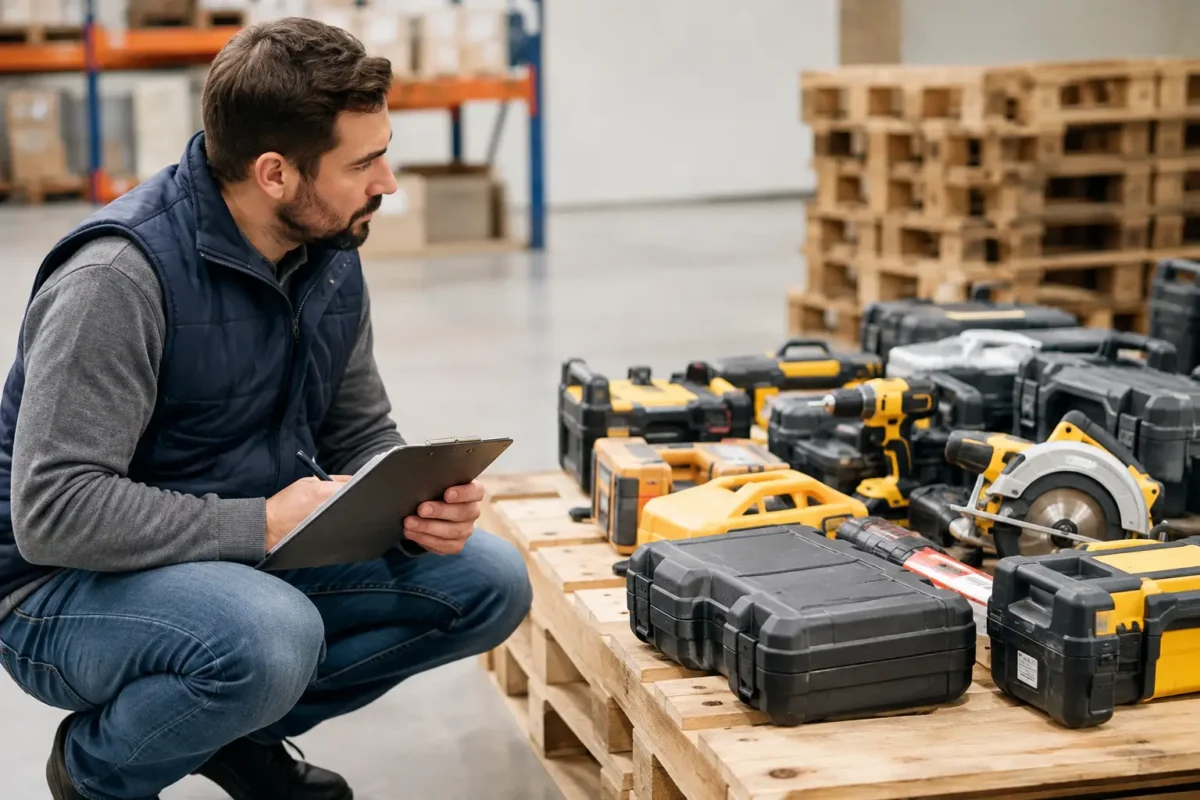
When reviewing a load in person, look for open packaging, missing serial labels, damaged cords, cracked housings, signs of battery corrosion, and mismatched components. Check whether boxed tools are actually inside their boxes. For powered equipment, inspect the plug, trigger, safety guard, battery terminals, and charger connection before placing a retail value on the item.
Completeness changes the resale price
A bare tool may still sell, but not at the same price as a complete kit. A drill without a battery or charger can be a good opportunity only when you have a ready market for tool-only units or compatible accessories. A miter saw without a guard or a pressure washer without its hose may be difficult to sell responsibly.
Build your expected resale value around what is physically present. If accessories are missing, reduce your projected sales price immediately. This prevents one of the most common liquidation mistakes: using the retail price of a complete boxed kit to value an incomplete return.
Brand recognition helps, but demand closes the sale
Well-known professional and consumer tool brands usually draw more buyer attention, but your market should decide what you buy. A contractor-heavy region may support faster sales for cordless platforms, saws, compressors, and generators. A flea market audience may respond better to affordable hand-tool sets, work lights, measuring tools, and home repair items.
Consider where each product will be sold. Heavy tools can be expensive to ship individually, which makes them better for local pickup, storefront sales, or weekend markets. Compact tools and accessories are often easier to list online. A pallet with a broad mix can work well for a multi-channel reseller, while a specialist may earn more from a focused lot built around a familiar brand or category.
Calculate the Real Landed Cost
The purchase price is only the starting number. To review tool pallets accurately, calculate your landed cost before committing to inventory. Include the pallet price, freight, liftgate or delivery requirements when applicable, unloading labor, storage, testing supplies, marketplace fees, and expected losses from unsellable goods.
A practical formula is simple: total your acquisition and handling costs, then divide that number by the units you realistically expect to sell. Do not divide by every item on the manifest. Some units will be incomplete, slow-moving, damaged, or better suited for parts.
For example, a pallet may appear to contain 80 items. After inspection, you may find 55 retail-ready units, 15 units that need accessories or repair, and 10 units with little resale value. Your margin plan should be built on the 55 ready-to-sell items plus a conservative recovery estimate from the remaining inventory.
Freight deserves close attention because tools are dense, heavy merchandise. A pallet that looks inexpensive can lose its advantage when shipping crosses several states or requires special delivery arrangements. Quote-based freight helps buyers see the full cost before purchasing, which is far better than treating transportation as an afterthought.
Build a Review Scorecard Before You Buy
A consistent scorecard keeps emotion out of the purchasing decision. Before buying a tool pallet, rate the load on these four areas:
- Condition confidence: Is the inventory new, shelf pull, returned, tested, or untested? Is the condition description specific?
- Sellable-unit count: How many pieces are complete enough to sell without repair, replacement parts, or major discounting?
- Market fit: Can you move these tools through your store, online channels, local marketplace, or flea market audience?
- Landed margin: After freight and operating costs, is there enough room for profit at realistic selling prices?
A pallet does not need a perfect score in every area. A return pallet with uncertain condition can still be a strong buy if the cost is low enough, the brands are desirable, and you have the skills to test, repair, or part out merchandise. On the other hand, a clean-looking load can be a poor purchase if its delivered cost leaves no margin after normal selling expenses.
Match the Pallet to Your Operating Model
New resellers often do better with smaller or more clearly described lots. The goal is not to chase the highest advertised retail value. The goal is to learn how fast tools move, how much time inspection takes, and which types of inventory your buyers request. A manageable purchase also gives you room to price competitively while you build customer trust.
Experienced operators may benefit from larger mixed tool loads or truckload opportunities because they can spread freight across more units, process inventory faster, and use several sales channels. They may also have technicians, parts inventory, or established buyers for imperfect goods. Scale can improve the economics, but only if your receiving, sorting, and storage process can keep up.
At American Prime Pallet Liquidators LLC, buyers can evaluate wholesale opportunities with the same business-first approach: understand the inventory type, request freight information, and buy at a level that fits their resale operation. Clear questions before purchase protect both your cash flow and your selling time.
The best tool pallets are not always the ones with the biggest retail number. They are the loads you can inspect confidently, receive affordably, price realistically, and turn into cash without tying up your business for months.
