No products in the cart.
Blog
How Bulk Merchandise Pallets Build Resale Margin
30
Jul
Jul
A pallet can look like a bargain long before it becomes a profitable buy. Bulk merchandise pallets give resellers access to customer returns, overstock, shelf pulls, and mixed retail inventory at below-retail cost, but the purchase price is only one part of the equation. The buyers who build dependable margins know what they are buying, where they can sell it, and what it will cost to get the load from the warehouse to their sales floor, storage unit, or fulfillment space.
For a flea market seller, a discount store operator, or an online merchant, pallet liquidation can create a steady inventory pipeline that is difficult to match through traditional wholesale. It also requires practical buying discipline. A mixed pallet may contain fast-selling products, slower-moving items, open-box goods, and merchandise that needs testing or cleaning. The opportunity is real, but the process works best when the pallet fits your business model instead of simply fitting your budget.
What Bulk Merchandise Pallets Can Include
Liquidation inventory enters the market for different reasons. Retailers need room for new seasonal assortments. Manufacturers close out discontinued lines. Customer returns cannot always return to a retail shelf. Shelf pulls may still be sellable but no longer fit a store’s planogram or selling season.
That is why one pallet is rarely identical to the next. Buyers may find electronics, power tools, shoes, clothing, cosmetics, kitchenware, home goods, toys, seasonal merchandise, or general mixed inventory. Some loads are category-specific, while others are designed for buyers who need variety in a discount retail environment.
Condition matters as much as category. Overstock is generally the most predictable because it is often new, excess inventory. Shelf pulls can be new or near-new but may have retail labels, damaged packaging, or seasonal timing concerns. Customer returns can offer stronger unit value, especially in electronics and tools, but typically require more sorting, testing, and grading. Mixed merchandise brings broad selling options, although it can take longer to process.
A smart purchase starts with matching the inventory type to your operation. If you need ready-to-stock merchandise for a small store, shelf pulls and overstock may be easier to manage. If you have the labor and product knowledge to inspect, repair, or bundle items, returns can provide more room for margin. Neither approach is automatically better. It depends on your sales channels, available space, and how quickly you need inventory to turn.
Calculate Landed Cost Before You Buy
The pallet price is not your true cost. Landed cost is the full amount invested before the first item is listed, displayed, or sold. Buyers who skip this calculation often overestimate their margin, particularly on lower-priced mixed loads or shipments traveling long distances.
Start with the pallet or truckload price, then add freight, unloading needs, sales tax when applicable, storage, labor, cleaning supplies, testing materials, marketplace fees, and expected losses from unsellable units. If you need to rent a lift gate, hire unloading help, or make room in a storage facility, include those expenses too.
For example, a pallet purchased for $900 may appear attractive based on its estimated retail value. But if freight costs $250, two team members spend several hours sorting it, and 15 percent of the units are not resellable, the economics change. Retail value is a reference point, not a guarantee of revenue. Your expected recovery value should reflect the condition of the goods and the prices your actual customers will pay.
The most useful number is projected net recovery: the revenue you reasonably expect after selling costs, less the complete landed cost. Keep your estimate conservative. A pallet that still produces a worthwhile return under cautious assumptions is usually a better buy than one that only works if every item sells at full market price.
Ask for the Details That Affect Resale Value
Supplier transparency reduces surprises. Before purchasing, request the information that helps you assess the lot rather than relying on a broad category label alone. Depending on the inventory type, that may include a manifest, estimated unit count, condition description, sample photos, brand mix, pallet dimensions, and any stated retail or recovery value.
A manifest can be helpful, but it should be treated as a buying tool rather than a promise. Inventory can be subject to count differences, packaging changes, returned goods, and normal liquidation variance. For unmanifested or mixed pallets, the condition grade and source are often even more important because they tell you how much processing may be required.
Confirm the following before you commit to a larger order:
- Whether the lot is overstock, shelf pulls, returns, salvage, or a combination of conditions
- Whether the pallet is manifested, partially manifested, or sold as unmanifested mixed merchandise
- The approximate pallet weight and dimensions needed for freight planning
- Any restrictions on resale channels, export, brand handling, or marketplace listings
- The pickup location, delivery process, and unloading requirements
These questions are not about slowing down the sale. They are how serious buyers protect cash flow. A dependable supplier should be able to explain the condition, purchasing process, and freight quote process in straightforward terms.
Choose Pallets That Fit Your Selling Channel
The best liquidation pallet for an online seller may be a poor fit for a bin store, flea market booth, or neighborhood discount shop. Your selling channel determines what kind of inventory you can move efficiently.
Online sellers often benefit from recognizable brands, compact products, and items with enough value to justify photographing, testing, packing, and shipping one at a time. Electronics accessories, tools, shoes, beauty products, and small home goods can work well when condition is accurately represented. The trade-off is higher labor per unit and competition from other marketplace sellers.
Discount retailers and flea market vendors can often move mixed general merchandise more quickly because shoppers respond to variety and value. Lower-priced items may not need individual listings, and imperfect packaging can be less of a barrier. However, these buyers need regular foot traffic, organized displays, and enough space to sort inventory into clear price points.
Truckload buyers operate at another level. Full truckload liquidation lots can reduce the per-pallet cost and support a larger retail operation, but they also increase the consequences of a poor fit. A truckload is most effective when you already understand your sell-through rate, have storage capacity, and can process incoming inventory without tying up working capital for months.
Turn a Pallet Into Sellable Inventory Quickly
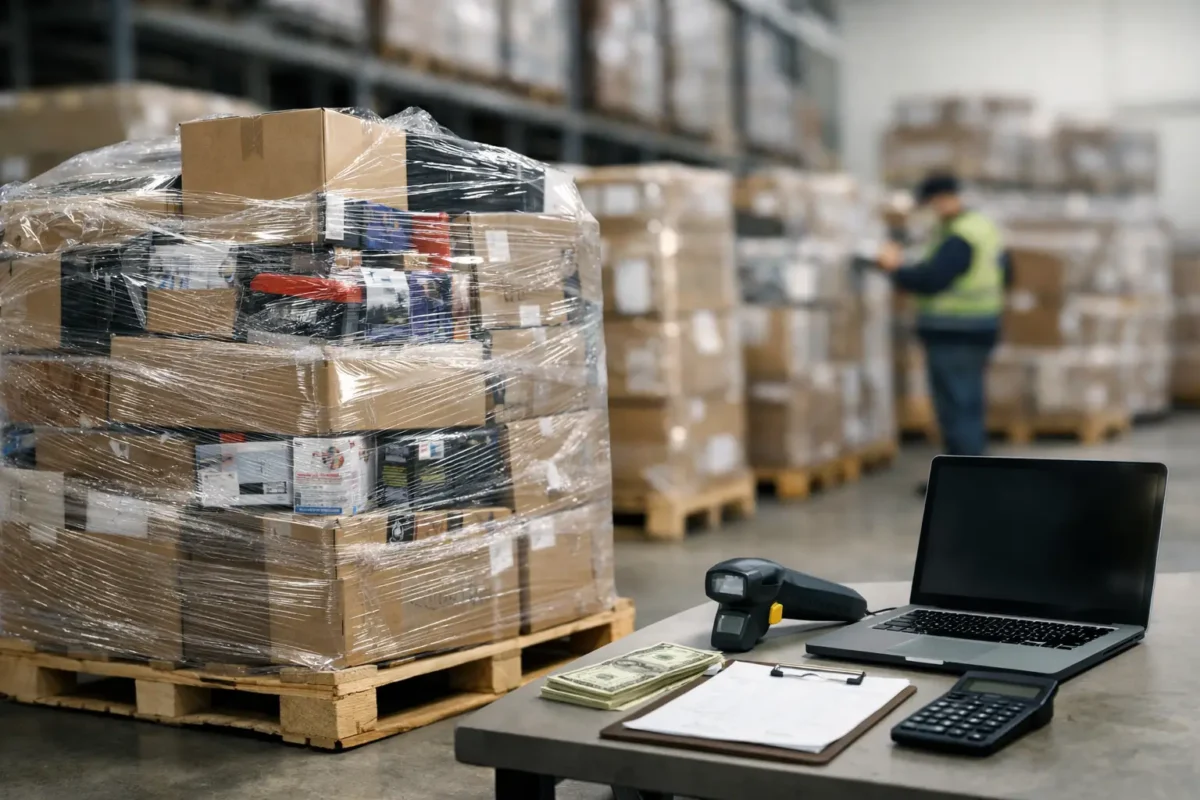
Profit is often decided after delivery. Letting a pallet sit unopened turns a potentially valuable purchase into dead inventory. Build a repeatable receiving process so you can identify sellable merchandise, price it, and move it into the right channel fast.
Separate items by condition first: new or retail-ready, open-box, tested working, needs attention, and unsellable. Then group them by category and sales channel. A clean, complete kitchen appliance may be worth listing individually online, while a group of lower-value housewares may perform better as a bundle or in-store value section.
Test higher-value products early. Electronics, tools, and battery-operated items should not be priced as fully functional unless you have verified them. Photograph condition issues honestly, keep basic records of what was received, and use simple labels that make inventory easy to find later. This protects your reputation with customers and gives you real data on which sources and categories produce the strongest returns.
Do not overlook the value of bundles. A single low-cost accessory may not justify listing and shipping on its own, but grouped with related items, it can become a practical offer. The same is true for incomplete products. In some cases, parts and accessories have value to repair buyers even when the original item is not retail-ready.
Build a Sourcing Plan, Not a One-Time Purchase
The goal is not to buy the cheapest pallet available. The goal is to establish a repeatable supply of merchandise that your business can process and sell profitably. Start with an order size that fits your available cash, labor, and storage. Track what sold, what required work, what did not move, and which categories produced the best net return.
As your data improves, you can buy with more confidence. You may find that mixed pallets drive store traffic, while tools provide stronger online margins. You may learn that cosmetics move quickly only when expiration dates and seals are carefully checked, or that seasonal goods need to arrive well before the season begins. Those insights are more valuable than a one-time retail-value estimate.
American Prime Pallet Liquidators LLC supports buyers looking for inventory across pallet and truckload quantities, with practical guidance on product mix and quote-based freight coordination. The right conversation before an order can prevent avoidable costs after delivery.
A profitable liquidation business is built pallet by pallet, but it grows through consistent decisions. Buy inventory you can evaluate, ship it at a cost your margin can support, process it quickly, and let your actual sell-through numbers guide the next order.
